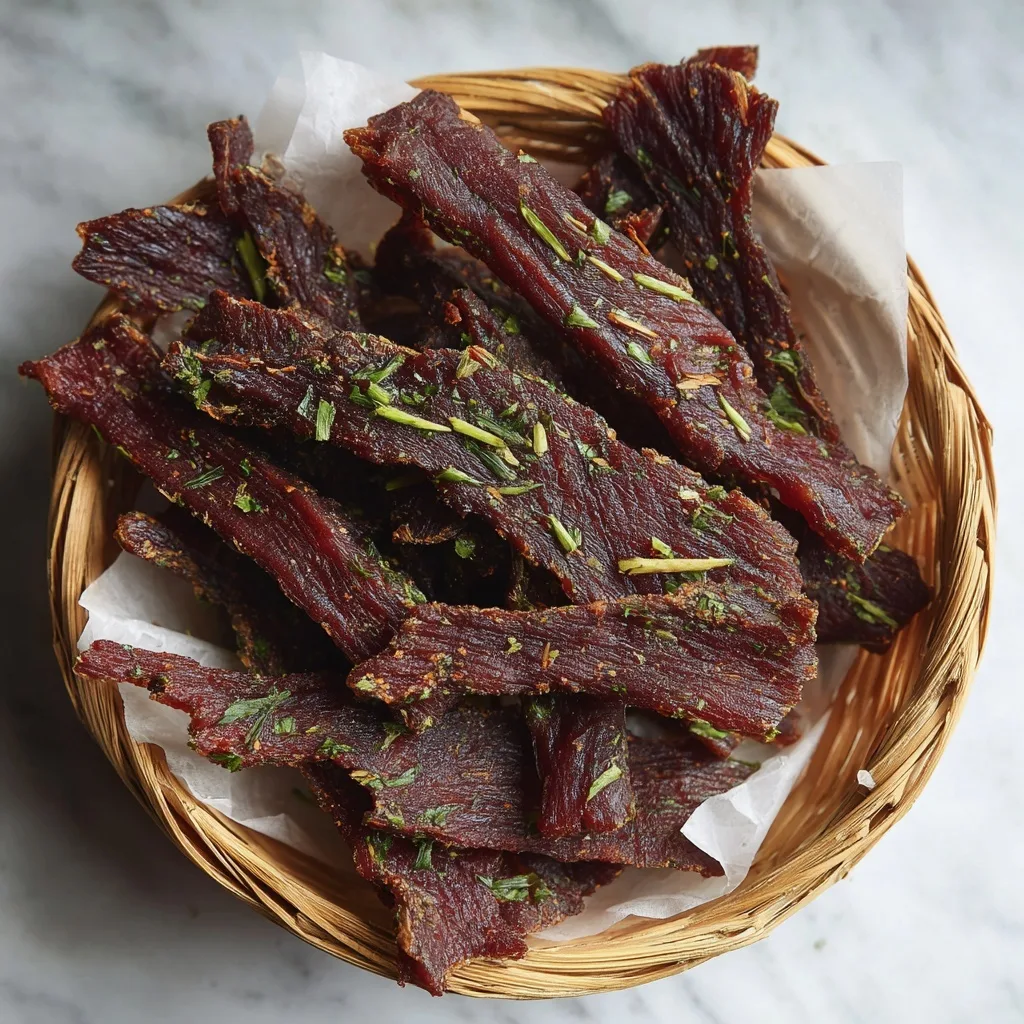
This herby, citrusy thai beef jerky recipe is what I make when I want big Thai street-snack energy without leaving my kitchen. It leans into makrut (kaffir) lime leaves for that perfume-y, almost floral lime kick, plus lemongrass, garlic, cilantro stems, and a salty-sweet backbone from fish sauce and soy sauce. The result is chewy (not tooth-breaking), savory, lightly sweet, and just spicy enough to make you reach for another piece. It's basically my at-home riff on thai sun dried beef, but done safely and predictably in a dehydrator or low oven so you're not depending on weather, sunlight, or sheer optimism. I like slicing the beef thin, letting the aromatics really sink in, then drying until it bends and cracks but doesn't snap. And yes: it's ridiculously good with sticky rice, so if you've ever Googled thai beef jerky and sticky rice, this is your sign to make both and call it dinner.
Herbed Thai Beef Jerky Infused with Kaffir Lime Leaves (Makrut Lime) - My Go-To Thai Beef Jerky Recipe
Herby, citrusy thai beef jerky with makrut lime leaves, lemongrass, fish sauce, and a gentle heat, dried until chewy and snackable.
Prep Time 30 minutes mins
Cook Time 7 hours hrs
Total Time 7 hours hrs 30 minutes mins
Sharp chef’s knife for thin slicing; a long slicing knife works too, and partially freezing the beef makes clean, even cuts much easier
Cutting board use a sturdy board; if you're worried about odor transfer from fish sauce, choose plastic or set down parchment paper
Mixing bowl medium size; a large measuring cup also works for whisking the marinade
Small Food Processor or Mortar and Pestle for turning aromatics into a paste; a microplane plus fine chopping works in a pinch, just aim for very small bits so they cling to the meat
zip-top bag or lidded container for marinating; a bag makes it easy to squeeze out air and keep everything coated
dehydrator with racks set to 160°F if your model allows; if you don't have one, use a rimmed baking sheet with a wire rack and your oven on its lowest setting with the door cracked
Instant-read thermometer optional but helpful for safety checks; you can also do a bend test for doneness, but temperature gives extra peace of mind
for the beef
- 1 ½ pound beef eye of round or top round; choose a lean cut for the cleanest, longest-lasting jerky (fat can go rancid faster)
for the herbed thai marinade
- 10 makrut lime leaves also sold as kaffir lime leaves; fresh is best, but frozen is excellent too
- 1 lemongrass stalk use the tender bottom 4 inches; slice thin so it blends smoothly
- 4 garlic clove peeled
- 6 cilantro stem or use 2 tablespoon chopped cilantro stems; stems bring more punch than leaves
- 1 teaspoon fresh ginger finely chopped; galangal is even more classic if you have it
- ¼ cup soy sauce use tamari for gluten-free; if using low-sodium, keep the fish sauce the same for flavor
- 3 tablespoon fish sauce brings the deep savory note that makes this taste like thai beef jerky instead of generic beef jerky
- 2 tablespoon palm sugar or light brown sugar; sweetness balances salt and helps browning as it dries
- 1 tablespoon tamarind concentrate or 1 tablespoon lime juice for a brighter, less tangy option
- 1 teaspoon toasted ground coriander warm and lemony; a sneaky way to reinforce the lime leaf flavor
- 1 teaspoon black pepper freshly ground if possible
- ½ teaspoon crushed red pepper or use 1 teaspoon gochugaru for a softer heat; add more if you like it fiery
- ½ teaspoon baking soda optional, but it helps tenderize and keeps the jerky pleasantly chewy instead of tough
for serving (optional but very on-theme)
- 2 cup sticky rice cooked; this turns the snack into the full thai beef jerky and sticky rice experience
- 1 lime cut into wedges for squeezing
- ¼ cup nam jim jaew or another spicy dipping sauce; store-bought is fine, homemade is better
slice the beef (the part that makes or breaks jerky)
Trim any visible surface fat or silverskin from the beef. Fat doesn't dehydrate well and can shorten shelf life, so this little step pays off later.
For easier slicing, place the beef in the freezer for 20 minutes (just until it firms up). Slice into strips about 1/8-inch thick. Slice with the grain for a chewier bite, or against the grain for a more tender, easier-to-tear jerky. Either way works; just keep thickness consistent so everything dries at the same pace.
make the aromatic marinade
Remove the tough center rib from the makrut lime leaves (fold the leaf in half and pull it out). Stack the leaves, roll them up tightly, and slice as thin as you can. This helps them release their oils and cling to the meat.
In a small food processor (or mortar and pestle), blend the sliced lime leaves with lemongrass, garlic, cilantro stems, and ginger to form a rough paste. You don't need it perfectly smooth, but you do want the aromatics very finely broken down.
Whisk the aromatic paste with soy sauce, fish sauce, palm sugar, tamarind, ground coriander, black pepper, crushed red pepper, and baking soda (if using). Taste the marinade: it should be salty-sweet with a bright tang and a strong herbal citrus aroma. If it tastes flat, add a pinch more sugar; if it tastes too sweet, add a splash more soy sauce.
marinate
Add the sliced beef to a zip-top bag or container and pour in the marinade. Massage and toss until every piece is coated and the aromatics are evenly distributed.
Refrigerate for 4 hours. If you want deeper flavor, you can go longer (overnight is great), but for this recipe's timing, 4 hours is enough for that unmistakable thai beef jerky punch.
dehydrate (dehydrator method and oven method)
Lift the beef out of the marinade and let excess drip off (you want the flavor paste on the meat, but not puddles). Arrange strips in a single layer on dehydrator racks with a little space between pieces.
Dehydrator method: set to 160°F and dry for 3 hours, rotating racks once if your machine has hot spots. Start checking at the 2 1/2-hour mark if your slices are very thin.
Oven method: line a rimmed baking sheet with foil for easy cleanup, set a wire rack on top, and arrange the beef in a single layer. Set the oven to its lowest temperature (ideally 170°F). Prop the door open slightly with a wooden spoon to let moisture escape, and dry for 3 hours, flipping strips once halfway through.
check doneness, cool, and store
Jerky is done when a strip bends and cracks but doesn't snap in half. If it snaps cleanly, it's on the drier side (still tasty, just less chewy). If it bends with no cracking, keep drying and check again in 20 minutes.
For extra safety, you can spot-check a few pieces with an instant-read thermometer; aim for 160°F in the thickest area.
Let the jerky cool completely on the racks before storing. Cooling prevents trapped steam, which can soften the jerky or encourage spoilage.
Store in an airtight container at room temperature for 3 days for best texture, or refrigerate for 2 weeks. For longer storage, freeze for up to 3 months and thaw at room temperature with the lid cracked so condensation doesn't sog it up.
Use a lean cut like eye of round or top round. They slice neatly, marinate well, and dehydrate into a chewy-but-not-greasy jerky. Flank steak works in a pinch, but it's usually a little less uniform and can end up tougher if you slice too thick.
Yes. The dehydrator is the most consistent way to get evenly dried strips, and this recipe is written with that setup in mind. Set your dehydrator to 160°F, keep strips in a single layer, and rotate racks if your machine runs unevenly.
Same flavor family, different technique. Thai sun dried beef is traditionally dried in the sun for a shorter time and then fried, so it can be more tender and juicy. This version is dried through to jerky doneness for a longer-lasting, snackable result, which also makes it feel closer to an asian beef jerky style you'd buy in a shop.
Use the bend test. A properly dried strip should bend and crack along the surface fibers, but not snap cleanly in half. If it folds like fresh meat, it needs more time. If it snaps, it's just drier (still safe and tasty).
You can, but it changes the process. For turkey breast (or chicken breast), slice very evenly and keep the temperature steady at 160°F; poultry jerky tends to dry faster and can go from perfect to brittle quickly. For the most reliable first try, stick with lean beef round.